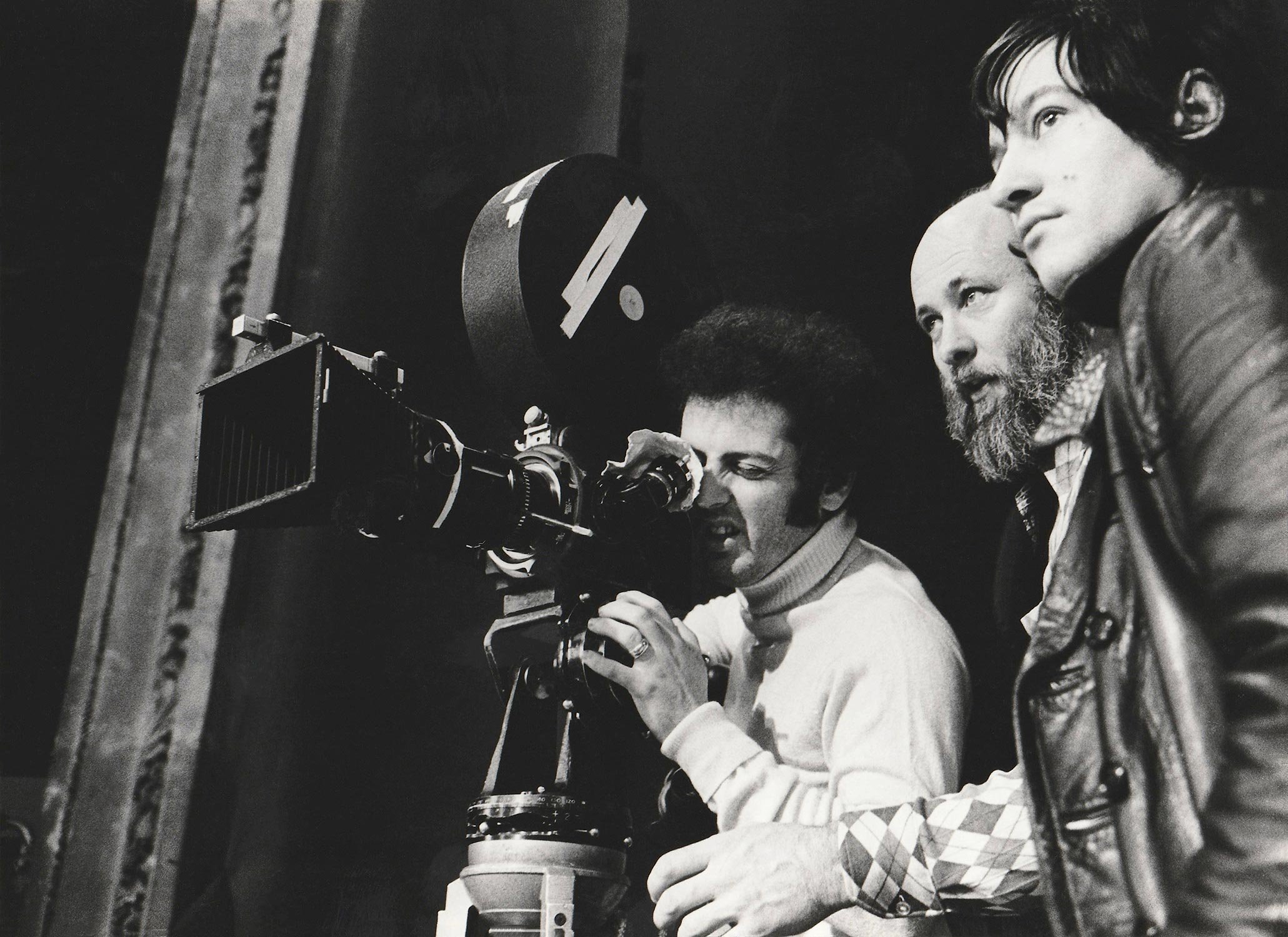
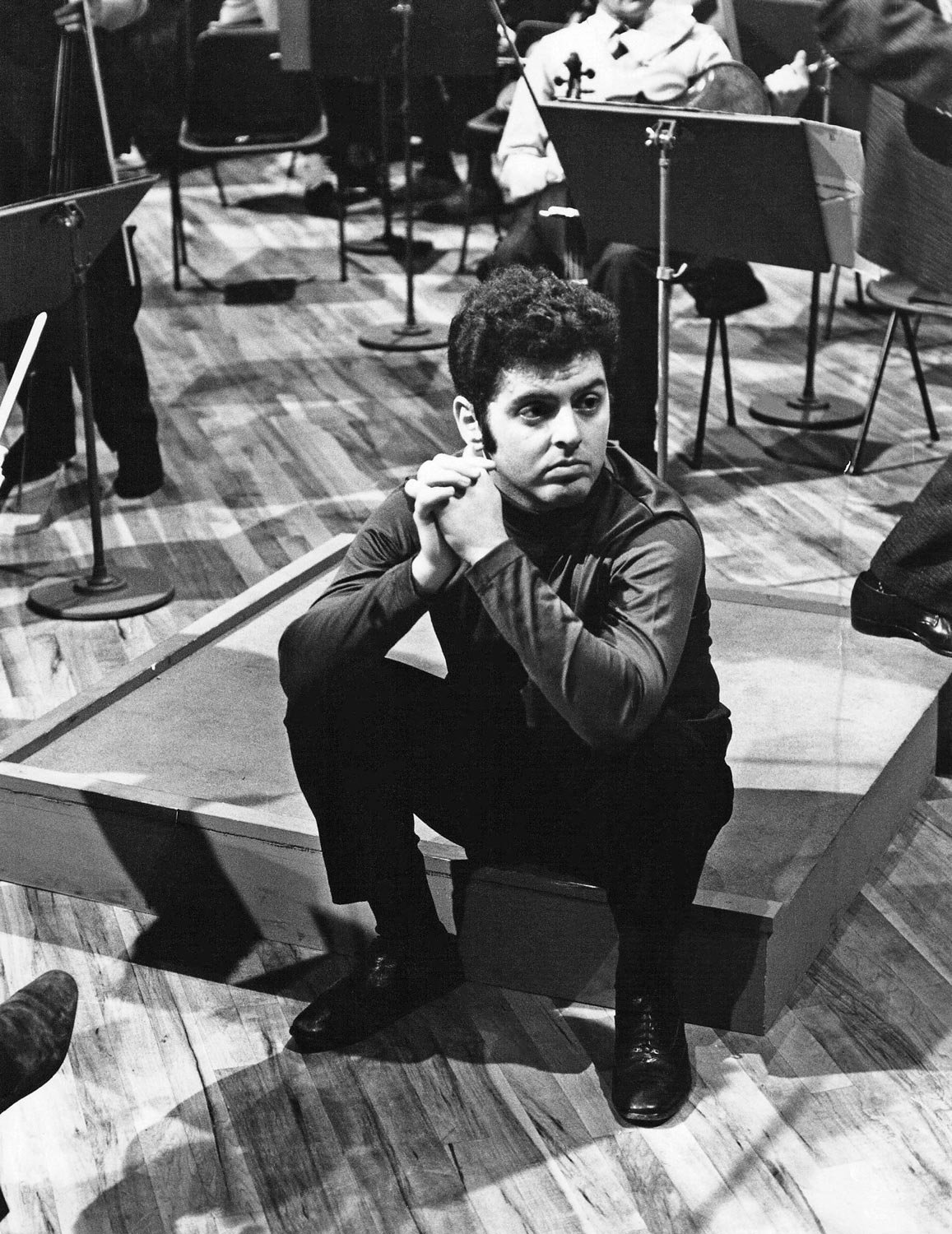
2020 marked the 250th anniversary of Ludwig van Beethoven’s birth and, to celebrate the occasion, we delved into the Allegro Films archive to unearth a forgotten series of recordings from 1969. Filmed at London’s famous Roundhouse Theatre in Camden Town, we encounter Daniel Barenboim in his late twenties, full of talent, charisma and early authority. During the episodes, he talks and plays extracts at the piano, illustrating the defining characteristics of Beethoven’s compositions and sharing his personal insight into the composer’s mindset.
Throughout the series, he addresses the camera directly as presenter (except for episode 3 which was originally shot as a pilot), adding to the intensity of the narrative. For orchestral pieces, he conducts the New Philharmonia Orchestra or plays at the piano with Sir Adrian Boult taking the conductor’s baton. Barenboim On Beethoven is a musical journey charting Beethoven’s progression in the context of his contemporaries such as Mozart and Haydn. Over twenty key compositions are performed and dissected, making this a unique body of work.
In December 2020, Channel 4 broadcast Barenboim On Beethoven: The Lost Tapes, as a two-hour Christmas special, presented by Sandi Toksvig, to encapsulate the highlights of the full series. All thirteen episodes aired on More4 and were made available on Channel 4’s digital platforms.


Full Episode Info
EPISODE 1: GENIUS & DESTINY
Duration: 25’ 45”
For the great Daniel Barenboim, Beethoven is an optimist—a man deeply attuned to the world’s problems who fights for “the triumph of the spirit over matter, over our problems,” even in the face of great sorrow. Drawing on excerpts from piano sonatas, concertos, and symphonies by Beethoven—and comparing them with superficially similar works by Mozart—Barenboim outlines what sets Beethoven apart from all others, what makes him a genius unto himself. “Nobody before him,” says Barenboim, “had written music like this”—and few have since, which is why everyone still knows his name 250 years after his birth.
MUSIC:
2nd symphony (extract) – Barenboim conducting – 01’ 55”
Piano Sonata No.1 (extract) - 01’ 08”
Beethoven’ C Minor Concerto (opening extract) – 00’ 07”
Mozart’s C Minor Concerto (extract) – 00’ 08”
Beethoven Sonata in C Minor (extract) – 00’ 29”
Mozart Sonata in C Minor (extract) – 00’ 29”
Mozart G minor symphony – open/close – 01’ 46”
5th symphony – opening transition (3rd to last movement) – 03’ 25”
-
EPISODE 2: NEW DIMENSIONS (minuet into scherzo)
Duration: 25’ 19”
In the second film Daniel Barenboim shines the spotlight on Beethoven’s innovations: just as he refused to show subservience to his aristocratic patrons or “assume the role of a cook", he flouted convention in music. He chose to enliven his sonatas and symphonies with a frenetic, intense Scherzo in place of the Minuet movement that was so engrained in tradition and society. Beethoven’s music was full of surprises, writing phrases with a bold or daring quality. Barenboim plays illustrative excerpts from Beethoven’s Piano Sonatas No. 3 and 4, and conducts the exuberant Scherzo from the Third Symphony (The Eroica), a movement that perfectly epitomises Beethoven’s liberated compositional style.
MUSIC:
C Major Piano Sonata, opus 2 No.3 (1st movement) - 07’ 46”
C Major Piano Sonata, opus 2 No.3 (extract) – 00’ 28”
Beethoven piano extract TBC – 00’ 18”
Hayden Symphony No.99 minuet, trio extract (Barenboim conducting) – 01’ 26”
Beethoven 4th piano sonata (extract) – 00’ 48”
3rd (Eroica) Symphony, complete scherzo – 06’ 45”
EPISODE 3: FORM: The Waldstein (piano sonata No: 53)
Duration: 26’ 20”
The musical structure of form "that suited Beethoven most was the sonata form”, says Daniel Barenboim, because it was based on “creating a unity from opposing ideas and themes.” In this third episode from the Barenboim on Beethoven series, Barenboim turns to the landmark “Waldstein” sonata - one of the most ingenious and technically demanding of the 32 piano sonatas. He talks about the glorious synthesis of “the most opposing elements… in life as well as in music” that was Beethoven. He also speaks sincerely of the task of the performer and the need to play a piece each time as if it were a fresh discovery; to “imbue the music with its own inherent spirit”. Then he shows us how it’s done with a bravura performance of the sonata’s first movement.
MUSIC:
Waldstein Sonata – opening (1st subject) – 01’ 55”
Waldstein Sonata – 2nd subject – 00’ 17”
Barenboim playing and talking: Waldstein (1st movement, 1st subject, 2nd subject, 1st subject, 2nd subject) – 01’ 16”
Waldstein – Development section – 01’ 35”
Waldstein – Recapitulation – 00’ 44”
Waldstein – 2nd subject, 1st subject – 00’ 15”
Waldstein, coda of the 1st movement – 01’ 59”
Waldstein, 1st movement (complete) – 11’ 10”
EPISODE 4: THE APPASSIONATA
Duration: 25’ 28”
The fourth instalment of Barenboim on Beethoven is an unforgettable recital: Barenboim’s fiery interpretation of the “Appassionata” Sonata (Piano Sonata No. 23), a spectacular encapsulation of the synthesis of extremes and contrasts so associated with Beethoven’s character. “Now savage strength, now trembling weakness,” in the words of Romain Rolland, the sonata unfolds in a vortex of conflicting emotion that the notes seem barely able to contain. From the first movement’s vertiginous uproar to the exquisite lyricism of the Andante and the thunderous catharsis of the final movement, Barenboim navigates each hairpin turn with the hands - and heart - of a master.
MUSIC:
Complete Piano Sonata No.23 in F minor, Op.57 (The Appassionata) – 22’ 44”
EPISODE 5: THE WORKING PROCESS (Leonora overtures No.2 & 3)
Duration: 26’ 01”
In this fifth chapter, Barenboim turns his attention to Fidelio (originally called Leonore), Beethoven’s only opera. Barenboim points out that Beethoven almost never rewrote his work, but his opera went through many modifications before finding the form in which it is most commonly performed today. Unpicking the Leonore Overtures Nos. 2 and 3, he describes the path that Beethoven took from one to the other and the musical reasons for his revisions. Barenboim explains why the Leonore Overture No. 3, often performed as a concert piece, is “a perfect instrumental music drama in its own right and one of [Beethoven’s] greatest symphonic movements,” an exquisitely constructed masterpiece in which “the music unfolds its own destiny.”
MUSIC:
Leonora Overture No.2 conclusion (conducted by Barenboim) – 03’ 59”
Leonora Overture No.3 (recapitulation) – 14’ 51”
EPISODE 6: THE FOURTH PIANO CONCERTO 1st Movement
Duration: 25’ 37”
Episodes 6 and 7 of Barenboim on Beethoven provide an up-close look at Beethoven’s Piano Concerto No. 4, which Barenboim describes as “one of the strongest reminders of the comprehensiveness of [Beethoven’s] vision”; a soulful and contemplative work that finds the composer at his poetic best. The piece holds a special place in the timeline of Beethoven’s life and career: its premiere marked his final appearance as a concerto soloist, and was part of the legendary December 22nd concert, in Vienna, 1808; the concert lasted four hours and also featured the premieres of the Fifth and Sixth Symphonies, as well as the Choral Fantasy. This episode highlights the first movement with its haunting and pensive introduction, bypassing the conventional orchestral presentation of thematic material and giving the first notes to the soloist alone. “For the first time,” says Barenboim, “a concerto really starts with the piano”: a bold choice that colours the rest of the work, unsurprising to our modern ears only because of Beethoven’s indelible influence on the music that came after him.
MUSIC:
The 4th Piano Concerto - 1st movement (opening) – 00’ 19”
The 4th Piano Concerto - 1st movement (extract) – 00’ 37”
The 4th Piano Concerto - 1st movement (complete), conducted by Sir Adrian Boult – 19’ 35”
EPISODE 7: THE FOURTH PIANO CONCERTO 2nd & 3rd Movements
Duration: 24’ 43”
The remarkable Fourth Piano Concerto concludes with Daniel Barenboim alongside Sir Adrian Boult and the New Philharmonia Orchestra. The second movement, evokes a stirring dialogue between “the opposite extremes of Beethoven”: what Barenboim calls “a dramatic, energetic, almost bestial orchestra” and the “angelic, naïve statements of the piano.” Barenboim praises the architecture of the concerto and shows us how the “relation of the detail to the whole… contains the greatest possible beauty.” A transition of “perfect symmetry” leads into the final movement, lyrical and witty, with trumpets and drums subtly entering the fray.
MUSIC:
The 4th Piano Concerto: opening of 2nd movement (extract) – 00’ 47”
The 4th Piano Concerto: 2nd movement (extract) – 02’ 10”
The 4th Piano Concerto: 2nd movement (extract) – 00’ 51”
The 4th Piano Concerto: 2nd & 3rd movements (complete); conducted by Sir Adrian Boult – 15’ 49”
EPISODE 8: THE A MAJOR CELLO SONATA, opus 69
Duration: 27’ 25”
Fifty years after its recording, episode eight captures the effortless musicality and irrepressible joy that have made generations of music lovers fall in love with Jacqueline du Pré. Having recently married Daniel Barenboim, “Jackie” joins her husband in this historic duet. In his introduction, Barenboim returns to Beethoven’s preoccupation with the pursuit of happiness and much has been made of a first-edition inscription by Beethoven on his Op. 69 Cello Sonata: inter lacrimas et luctus, “between tears and grief.” Barenboim cautions against relying too much on biography to make sense of music; this brilliant work was often credited as the first cello sonata to put the cello and piano on equal footing. It radiates serenity and joy, despite the inner turmoil that Beethoven felt at the time of its writing.
MUSIC:
A Major Cello Sonata, opus.69 (1st, 2nd and 3rd movements); featuring Jacqueline du Pré
EPISODE 9: THE EROICA
Duration: 27’ 18”
“I doubt whether in the whole history of the arts,” says Daniel Barenboim, “there has been such a great stride forward in such a short time… I believe it opens a new page in the history of human consciousness.” He is speaking about Beethoven’s Third Symphony, the Eroica, among the composer’s most celebrated works with its ties to Napoleon Bonaparte, Emperor of France. It was a watershed moment in the evolution of Beethoven’s artistry and the wider Romantic revolution.
MUSIC:
The Eroica (Beethoven’s 3rd symphony) opening (extract) – 00’ 59”
[Daniel Barenboim presenting to camera, and illustrative playing at the piano] – 07’ 52”
The Eroica (Beethoven’s 3rd symphony) 1st movement – 15’ 26”
EPISODE 10: THE SYMPHONIST
Duration: 25’ 37”
Barenboim suggests that when we think of Beethoven as a symphonist par excellence, it is not only because of his nine legendary symphonies; it’s also because “almost all his music, symphonic, instrumental or vocal, has a certain unmistakable symphonic character about it.” Sitting at the piano, Barenboim looks at the qualities with which Beethoven infused all his work - the “sheer breadth of his expression,” his “sensitivity for colour and sound… just as acute as that of the French Impressionists,” and his compulsion to depict and overcome the great struggle of the human condition. Barenboim warns us not to think of the so-called happier works like the 4th or 8th symphonies, as inferior; that they are just as quintessentially Beethoven as the 5th, the 9th or the Eroica symphonies.
MUSIC:
Piano Sonata No.15, Op.28 (Pastoral) – 00’ 32”
Piano Sonata No.29, Op.106 (The Hammerklavier) extract – 00’ 28”
Improvised piano example – 00’ 12”
Piano Sonata No.29, Op.106 (The Hammerklavier) extract – 01’ 00”
Piano Sonata No.29, Op.106 (The Hammerklavier) opening extract – 00’ 06”
[Daniel Barenboim presenting to camera, with brief illustration at piano]
4th symphony (opening) – 04’ 31”
8th symphony – 1st movement – 10’ 09”
EPISODE 11: SONATA NO.32, OP.111 – 1st movement (Beethoven’s last sonata)
Duration: 25’ 53”
If we had never heard Beethoven’s music before and decided to look at his final piano sonata, Op. 111, alongside his very first, we would be floored by the differences in tonal and formal expansiveness, the spontaneity, and compositional architecture; it might even seem unbelievable that the works had come from the mind of one composer. However, Barenboim, having already taken us through middle-period Beethoven - the “Waldstein”, the "Appassionata”, and the Eroica - argues that the “unmistakable quality” of the late works represents “a logical development of his whole life’s work.” This chapter of Barenboim on Beethoven focuses on the final sonata’s first movement, “some of the tensest music he ever wrote” in which he proves himself “a master of small forms.”
MUSIC:
Piano Sonata No.32, opus.111 (1st movement) opening extract – 00’ 29”
Beethoven String Quartet No.13, opus.130; finale extract – 00’ 42”
Piano Sonata No.32, opus.111 (1st movement) extract – 00’ 39”
C Major Cello Sonata, opus.102; last movement (extract) – 00’ 05”
String Quartet No.14 (C Sharp Minor), opus.131 – 01’ 14”
String Quartet No.14 (C Sharp Minor), opus.131 – 00’ 12”
String Quartet No.14 (C Sharp Minor), opus.131 – 00’ 09”
9th Symphony, opus.125, 1st movement (extract) – 01’ 25”
Bagatelles, Opus 119 (extract) – 01’ 57”
Piano Sonata No.32, opus.111 (introduction of 1st movement, bar 2, 11, principle theme illustrations) extract – 00’ 42”
Piano Sonata No.32, opus.111 (complete 1st movement) – 09’ 40”
EPISODE 12: SONATA NO.32, OP.111 – 2nd movement (Beethoven’s last sonata)
Duration: 25’ 44”
Of Beethoven’s 32 piano sonatas, the last one, Op. 111, is unique in its makeup, consisting of just two movements. Contemporaries wondered if a copyist had forgotten to send the third movement to the publisher, but no sketches indicate that Beethoven ever considered such an addition. For Barenboim, this is unsurprising, as the two movements balance each other out with a “prevailing inner logic”: if the first movement, “with its terrifying energy, shows us only one side of Beethoven’s nature… this world with all its struggles,” the second - variations on an Arietta - presents a vision of “eternity undisturbed,” a profoundly spiritual expression of a pure innocence “consciously won, through the lessons of experience.” At once monumental and unadorned, the final movement of the final sonata marks the denouement of one of the most epic journeys in Western art, a spiritual encounter in which we are liable to learn things "not only about the music, but about ourselves.”
MUSIC:
Piano Sonata No.32, opus.111 (2nd movement); illustration of theme (extract) – 00’ 50”
Piano Sonata No.32, opus.111 (complete 2nd movement) – 19’ 22”
EPISODE 13: THE FIFTH SYMPHONY
Duration: 37’ 37”
The Barenboim on Beethoven series concludes with this spirited performance of Beethoven’s Fifth Symphony, with the young Barenboim at the helm of the New Philharmonia Orchestra. For many, this symphony is Beethoven. There is no motif in Western music more widely known or parodied than the one that opens Beethoven’s Fifth Symphony, with its hammer blows of fate. As the work unfolds, it becomes a journey from darkness to light. The Andante is as soulful and stirring as anything in Beethoven’s repertoire and the transition from the mischievous Scherzo into the triumphant Finale is one of the most gloriously exultant moments in music, completing the mythical passage from the weighty darkness of the C minor first movement to a jubilant burst of light in C major.
MUSIC:
The 5th symphony – performance only (complete) conducted by Barenboim – 35’ 19”
Our Films on DVD

This DVD celebrates the musical quest of one of the great symphonists of the twentieth century; Jean Sibelius, as seen through his music, his letters and the words of his wife Aino, who was with him for more than sixty-four years. His quest was not an easy one. Living through the great turning point in Western music, many of his concerns were strikingly similar to those of Schoenberg and Stravinsky but each chose a different path.
Sibelius once said that while his colleagues were serving multicoloured cocktails, he offered only pure spring water. The metaphor is a good one but, as so often with artists who take an untrod path, critical opinion has fluctuated wildly. In 1935 Sibelius was voted the most popular composer of all time by the members of The New York Philharmonic Society, a view that was echoed by many of the leading critics and composers in England.
By the 1950s critical opinion had relegated Sibelius to a position of minor importance.
Views are changing again and the time seemed right for an intimate look at what Sibelius himself felt that he was trying to achieve. The film in two-parts on this DVD is an attempt to do just that.

A film about the man who made himself the most talked about, the most famous, the most successful, the richest, and the most controversial classical soloist that the world of music has ever known.
The film on this DVD presents Paganini's music, filmed and edited in the style developed by Christopher Nupen and his colleagues for their prize winning DVDs about Sibelius, Schubert and Tchaikovsky and combines it with extracts from Paganini's letters and quotations from both his admirers and his many detractors.
While being hailed as the greatest performing musician of his time, Paganini was denounced again and again by knowledgeable critics as a charlatan in league with the devil and an avaricious man with scant respect for those who responded so enthusiastically to his unforgettable gift - and contributed so readily to his vast personal fortune.
In time this provoked envy and resentment and, finally, a pitiable isolation. By the time of his death, at the age of 57, his unbending quest for gold and for glory had robbed him slowly of almost everything else.
The bonus track is a sequence called Gidon Kremer, Perfectionism and the Thirteenth Caprice from Christopher Nupen's film Gidon Kremer: Man of Many Musics.

This DVD contains two of the most famous Schubert films — each entirely different from the other in style, content and spirit.
The first, The Trout, presents a youthful explosion of exuberant talent; starting with Schubert himself — who wrote his Trout Quintet when he was 22 years old. His lead is picked up and brought to life by five extravagantly gifted young musicians when they were barely older than Schubert had been when he wrote the piece. Their names: Daniel Barenboim, Itzhak Perlman, Pinchas Zukerman, Jacqueline du Pré and Zubin Mehta.
The film was shot in a single week in August of 1969 and culminates with a performance of Schubert's Trout Quintet, filmed live on-stage at the new Queen Elizabeth Hall, on the south bank of the Thames, in London.
The second film, The Greatest Love and the Greatest Sorrow, looks at Schubert's astonishing achievements in the last 20 months of his life - after the death of his god, Beethoven. He asked the question, "Who would dare to do anything after Beethoven”? The answer, of course, was Franz Peter Schubert, in the music which he wrote after Beethoven's death.