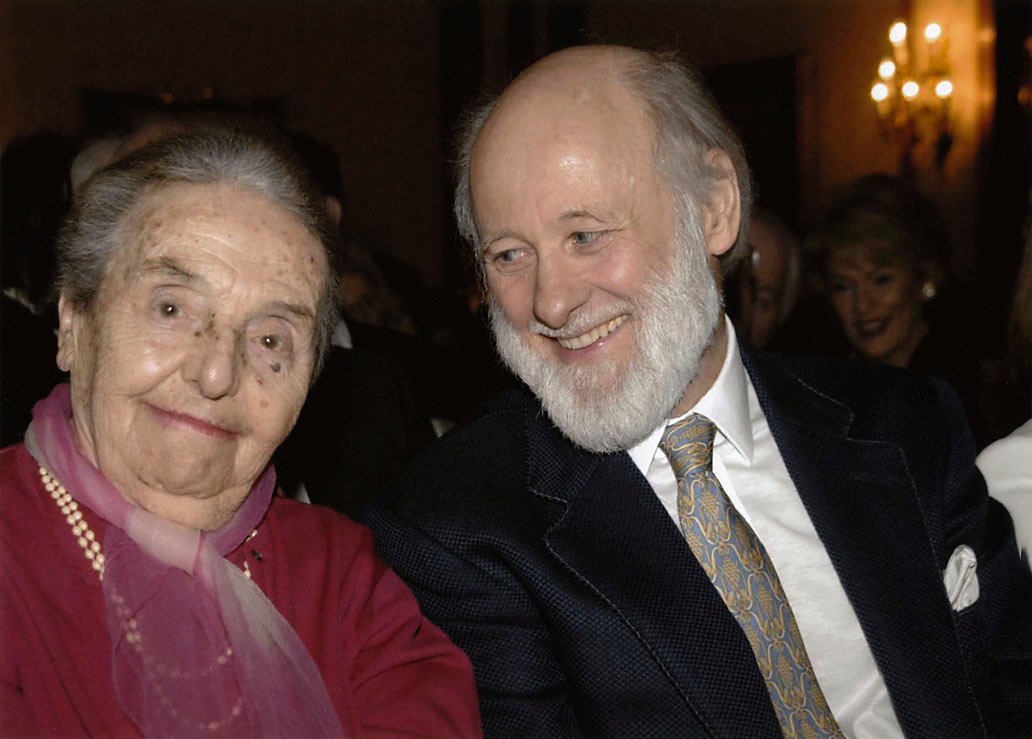
Info:
Duration: 53’ 00”
Narrated by Christopher Nupen
Year of production: 2010
Accolades:
Winner of the World Bronze Medal at the New York Film and Television Festival, 2010
Nominated in the Social Award category at the Rose d’Or Festival 2010
At 110, Alice Sommer Herz was the second oldest person in London, lived entirely alone in a small flat and practised the piano for two and a half hours every day.
She was one of the most remarkable people in the world and was thought of with admiration and affection, by hundreds of thousands of people, as both a sage and a saint.
Her wisdom was evident in almost everything that she said. Her saintliness seen in her almost unique tolerance and her compassion. She had, among her virtues, the gift of true forgiveness.
She was imprisoned, with her six-year-old son, in the Theresienstadt concentration camp and saw unspeakable atrocities but she did not hate her persecutors because she had the wisdom to know that all hatred hurts the soul of the hater, while it makes little or no impression on the hated, except, perhaps, to make them worse.
-
She suffered experiences which no human being should have to endure, including the deaths of both her mother and her husband at the hands of the Nazis, and yet she speaks about her experiences with a simplicity and a quiet grace that win the hearts of all who discover her.
In this film she remembers her inability to feed her child in the camp, and to answer his questions, as an indescribable nightmare; she remembers also playing more than 100 concerts in the camp and likens the experience, both for the performers and for the listeners, to religious experience and feeling close to the divine. She is in no doubt that music saved her life in those unimaginable circumstances — and the lives of hundreds of others.
She elaborates on this theme in this film.
At 104 she published a book about her life and experiences. That is to say, two writers in Hamburg compiled a book from hundreds of conversations with her over nearly 3 years.
That book, A Garden of Eden in Hell, rapidly became a best-seller and has already been printed in seven languages.
Gigi Sommer is also the heroine of our prize-winning film, We Want the Light, which, through television, has won her a devoted following in many parts of the world.
She also plays the piano in this film — Schubert, Smetana and Beethoven — in a style which the world has long forgotten. It is the style of Artur Schnabel, who was one of her teachers; a style redolent of a happier and more confident time in music making and one which many will find heartwarming. When Pinchas Zukerman heard it he said, “Wow! You don’t hear phrasing like that any more.”
Film remembers our artists in a way that not one of the other media is quite able to match and Gigi Sommer is a human being, a woman and an artist worth remembering.
This is one of the very few films on a holocaust subject that focuses on hope, tenacity and human dignity rather than on catastrophe and despair.


Our Films on DVD

How many have the gift of forgiveness? And how many are free of hatred? Alice Sommer Herz had both of those qualities with an extraordinary depth of perception and natural wisdom. She was imprisoned, with her six-year-old son, in the Theresienstadt concentration camp and saw unspeakable atrocities. She lost both her mother and her husband in Nazi death camps but she does not hate her persecutors. That is not because they are anything other than monstrous criminals but because she has the wisdom to know that all hatred hurts the soul of the hater, not the hated and Gigi Sommer's inspiring soul is among the things which she kept intact and unblemished through her hundred and ten years on Earth.
She was a pianist of distinction, played more than 100 concerts in the Theresienstadt camp and is in no doubt that music saved both her sanity and her life and the lives of many others in those unimaginable circumstances. She elaborates on this theme in the film.
Ask her what has made her happy and she says, "Love, nature and music, which is the most beautiful thing coming out of mankind. This is my religion”. And ask her what she has learned in her long life and she says, "To recognise the difference between what is important and what is not important” and “to be grateful for everything, because life is beautiful and everything is a present."

This is a DVD about many things. It is about freedom and captivity, about emancipation, acculturation and assimilation; it is about the roles played by Moses and Felix Mendelssohn in the dream of fruitful, unproblematic integration of the Jews into German society after their liberation from the ghettos; it is about Richard Wagner, his essay Das Judenthum in der Musik (The Jews in Music) and his influence on the thinking of the Third Reich but, most of all, it is a DVD about how much music can mean to people, even in the direst of circumstances, or particularly in the direst circumstances.
The title, We Want the Light, is taken from a poem by a 12-year-old girl, Eva Pickova, written in the Theresienstadt concentration camp. Her words provide both the title and the climax - in a setting for two choruses and orchestra by the American composer Franz Waxman, in his work The Song of Terezin. The DVD also contains music by Mahler, Bach, Schoenberg, Bruch, Schumann, Mendelssohn, Wagner, Schubert, Bloch and Brahms.
With the Gürzenich Orchestra of Cologne, the Cologne Opera Chorus, and the Cologne Cathedral Children's Choir, conducted by Vladimir Ashkenazy.

This DVD presents Vladimir Ashkenazy as pianist, conductor, musical guide and master musician - an intimate and engaging view of one of the world's most quietly successful musicians.
It contains the portrait film Vladimir Ashkenazy: The Vital Juices Are Russian, shot in 1968 when Ashkenazy moved with his wife and son from London to Iceland, an important turning point in his life and career.
Since that film was made, Ashkenazy the pianist (possibly the most frequently recorded pianist in history, his discography runs to 56 pages), has also become an international conductor of the highest rank and we include a montage of sequences from our composer films with Ashkenazy as conductor. It also contains a short interview with Ashkenazy who talks, in his modest but penetrating way, about musical gifts and their origins.
The DVD ends with a film about Rachmaninov's Corelli Variations. In it Ashkenazy discusses the piece at length, with great affection and some telling musical insights. It ends with a complete performance of the piece, filmed at a public concert in Lugano.